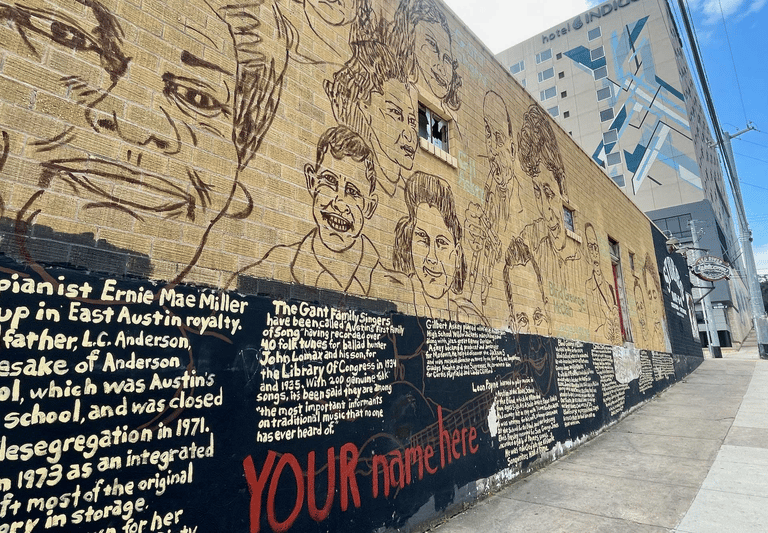
Blackland, like most East Austin communities of color, had been plagued by a history of disinvestment and predatory real estate speculation. Blackland’s situation was worsened by eastward annexations by the University of Texas at Austin that were endorsed by the 1928 Austin Master Plan, that called for relocation of people of color from West Austin to East Austin and simultaneously called for the University of Texas to grow eastward. The plan was officially deemed as racist and abandoned by the city in 1956, but eastward annexation was pursued by UT until 1992. The combination of these factors created blighted housing conditions where rent was cheap but housing quality was very low.
In 1980, the UT Administration began its sixth annexation process that was intended to take all land to Chicon Street, including half of the Blackland Neighborhood.
The History of Blackland
Despite the forced segregation, a vibrant, diverse community emerged, fighting for survival. In the decades that followed, the City, State of Texas, and University of Texas began pulling out community roots as Blackland tenants lost homes to UT's eastward expansion.
In 1983, Charles Smith, Katherine Poole, and Bo McCarver formed Blackland Community Development Corporation. This Blackland community of diversity would have roots, a place to build history, a permanent place to call home through deeply affordable housing.
Growing Roots in Community
Stories of Roots
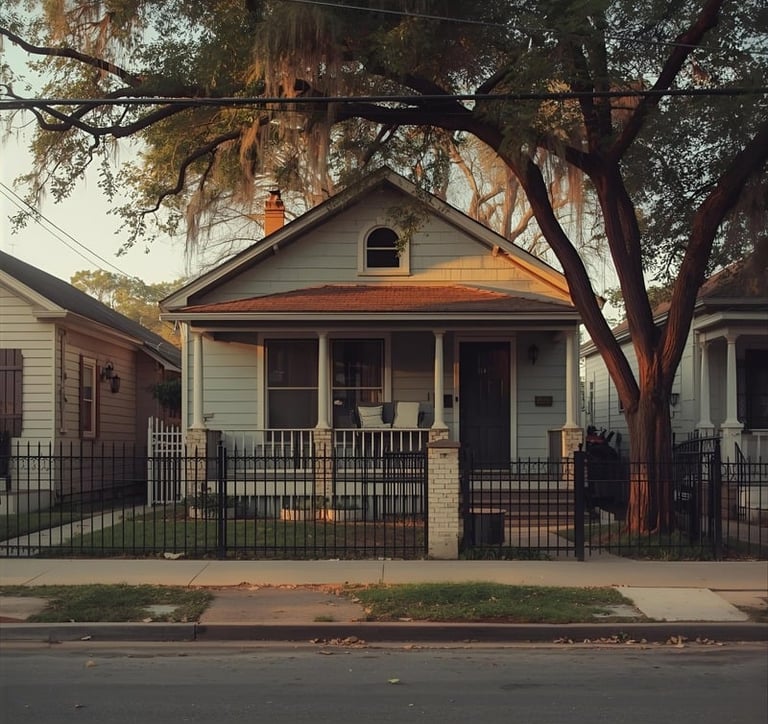
The Hardin House was owned and built in 1945 by Blackland Neighbor June Brewer who was born in 1925.
In 1950 June H. Brewer was one of the first African-American students admitted to the University of Texas at Austin. Immediately following the United States Supreme Court’s landmark civil rights decision in Sweatt v. Painter on June 5, 1950, Brewer submitted an application and was enrolled for the second term of the summer semester of 1950 along with W.D. McClennan, Wilhelmina Perry, Mabel Langrum, Emma Harrison, Bessie Randall, and Horace Lincoln Heath.
Her daughter, June Brewer Hardin, inherited the house and sold it to UT in 2004. The house was donated to BCDC by the University of Texas, and was moved in 2005 where it still stands today on the corner of 22nd and Leona. This historic structure stands as a monument of the civil rights struggle and has born witness to years of many success that followed those struggles. The growth of the relationship with the University is a perfect example of a new alliance for community preservation and opportunity.
Harden Brewer House
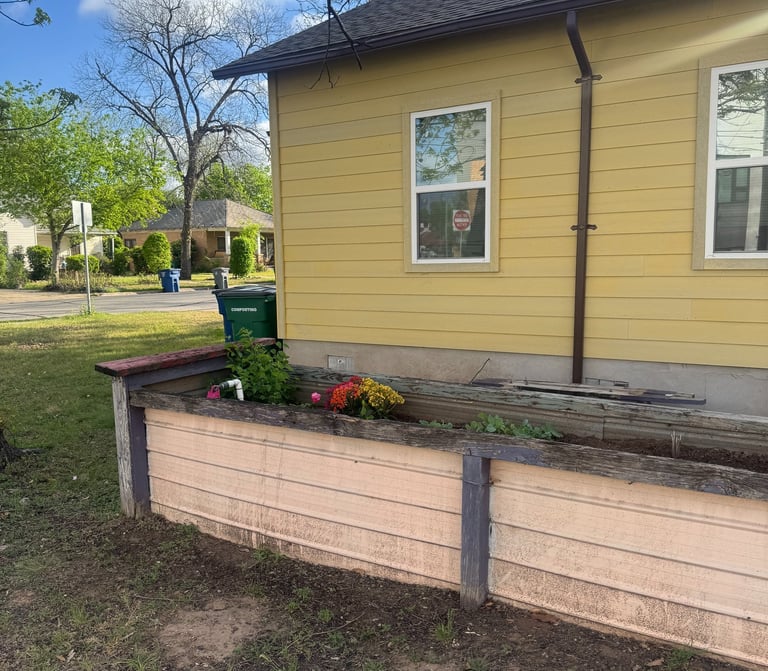
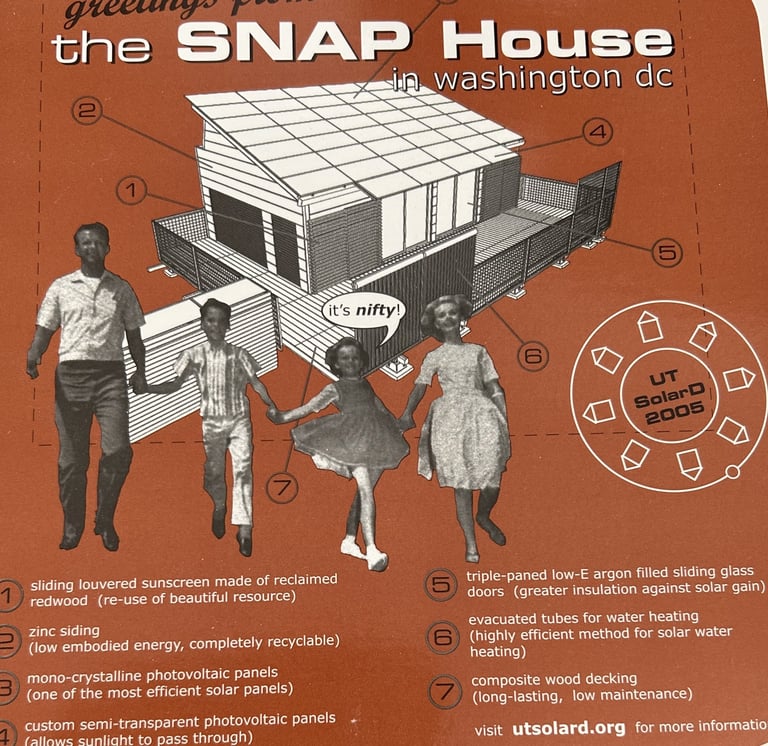
The Super Nifty and Portable (SNAP) House was donated to Blackland Community Development Corp. after competing in the U.S. Department of Energy Solar Decathlon 2005.
The House was built by UT's students form the school of architecture in 2005 entry in the U.S. Department of Energy's Solar Decathlon competition in Washington, D.C., an international contest in which colleges compete to design the best self-sufficient solar home. After the competition, UT donated the house to Blackland CDC, which paid to have it shipped back from D.C., to its current location, less than a block from where it was first assembled by students. On its west side, East 22nd separates the duplex from a sea of UT parking lots.
The building's design was creative, using steel beams to connect sections of the house together. This design is what allows for the house to be portable, as the sections can be broken down for transport. The house uses recycled styrofoam for insulation, a large solar panel, and efficient solar water heating. The cladding of the house is made from zinc plates from the Daily Texan. Closer inspection of the siding will reveal Daily Texan articles from 2005, making it a unique time capsule. (Please Do Not walk up to the house without permission from the current resident. This private property is home to a Blackland resident as part of Blackland CDC’s commitment to house low-income households in affordable housing.
SNAP House
In 2002, the City Council approved the Upper Boggy Creek Neighborhood Plan that included five sub-districts, one being the Blackland Neighborhood. Concerned about preserving affordable housing in the area, the Blackland Neighborhood included a provision that called for any new housing development with four or more units to be affordable for households earning less than 60% of the average for Austin.
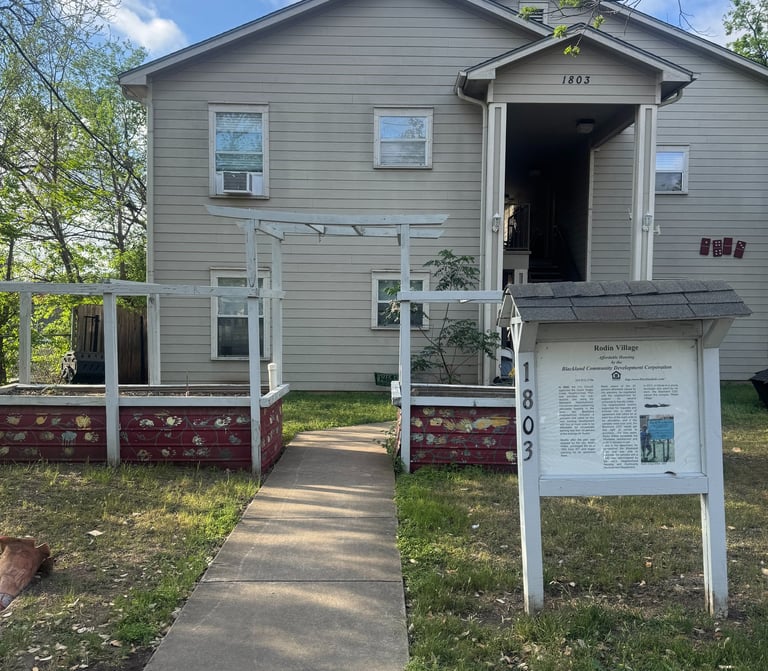
Shortly after the plan was adopted by the City, Rodin Wilber purchased the lot at 1803 East 20th Street and began planning for an apartment building there. Made aware of the 25% affordability clause by the City, he negotiated with the neighborhood for support for several variances to the city codes. Neighborhood leaders supported his requests and entered into a letter of agreement that called for at least two of the eight units to be affordable, and if the complex were ever sold, Blackland CDC would get first right of refusal to purchase. For nine years, Rodin Wilber exceeded the affordability requirement and in 2010 he decided to sell.
Loyal to the agreement, he approached Blackland CDC. Blackland was able to purchase the complex with a HUD loan administered by the City’s Neighborhood Housing and Community Development Department.
In 2011, in tribute to a young developer who stood by his word, Blackland CDC names this complex “Rodin Village.”
Rodin Apartment
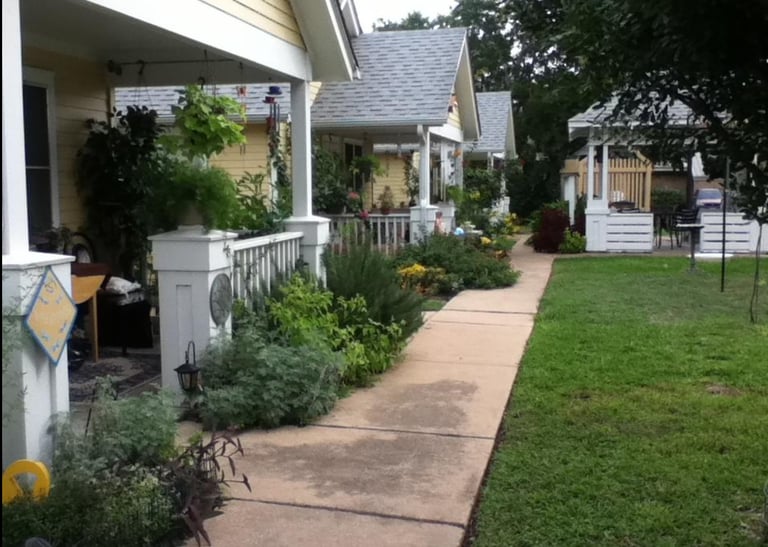
The Robert Shaw Echo Village is a 8 unit elderly housing for people with very low income and a disability. It is Texas first and only known Tiny Planned Unit Development. It is on a property leased to BCDC from the City of Austin. It is named after late great Blues Musician Robert Shaw who was the owner and proprietor of the Stop and Swat Grocery store. The former store is now home to the Salty Sow.
Bertram Allen, our retired maintenance and local historian, recalls going to the grocery store and listen to Mr. Shaw as he would leave the register, step up to his piano, and play the blues.
Robert Shaw Village
Know Someone Who Should Hear This Story?
Introduce us to funders, art advocates, or leaders who care about keeping Austin’s creative soul rooted here.