
Our History
The full founding story: UT battle, community resilience, and the dream that started it all.

Our Founders
At Blackland CDC, community is an integral component of safe and stable housing. We strive for everyone to be valued as a thread woven into the tapestry of our community. It is that deep sense of community that drives us to pursue opportunities that enable all to flourish.
Our community tapestry forms a safety net in times of need. That sense of sustainability withstands the test of time, insurmountable odds, and Goliath-level forces. We take strength from the many neighbors that founded this organization.
Our Founders:
Katherine Pool, Bo McCarver, Charles Smith
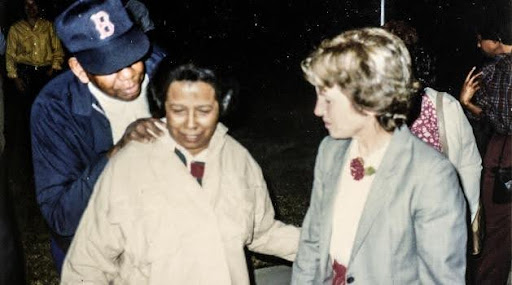
Photo: Charles Smith, Katherine Poole, Councilwoman Sally Shipman in the midst of fight to save Blackland neighborhood from University of Texas expansion (ca. 1985).

Two Symbols: The Domino and The Feather
There are two symbols central to Blackland CDC, the domino and the feather.
Austin's oldest and smallest Planned Unit Development happened right here in Central East Austin and is Robert Shaw Village. Much of the early BCDC community conversations were held waiting for meetings at City Hall and the corridors of boards and commissions meeting places, but there was a BCDC center at Robert Shaw. Many people would gather and play dominoes as plans, developments, and challenges of the day were discussed. Today you can see this dominoes conference style of deliberation displayed as the address of many of our BCDC homes.
In the aftermath of a huge battle with the City and developers, after bulldozers had finally razed many of the long-time homes, Bo McCarver walked the empty lots that were once home to long-time East Austin residents, one of whom had gone to the hospital and died in the night from a heart attack. The experience was a devastating loss. Later Bo saw a single black feather laying on the same ground and was filled with hope. Hope that once again, like a bird, this community would survive, thrive and fly.
Today we still follow the flight of the feather in a design made for us and donated by local tattoo artist, Amanda Howe. Celebrating and supporting the creative spirit is one of the most profound and unique abilities that has supported the BCDC Community. Whether the creative spirit is in a community faith, a band, on a canvas, or even an illustration inked onto an arm, we honor the diversity of every life experience.



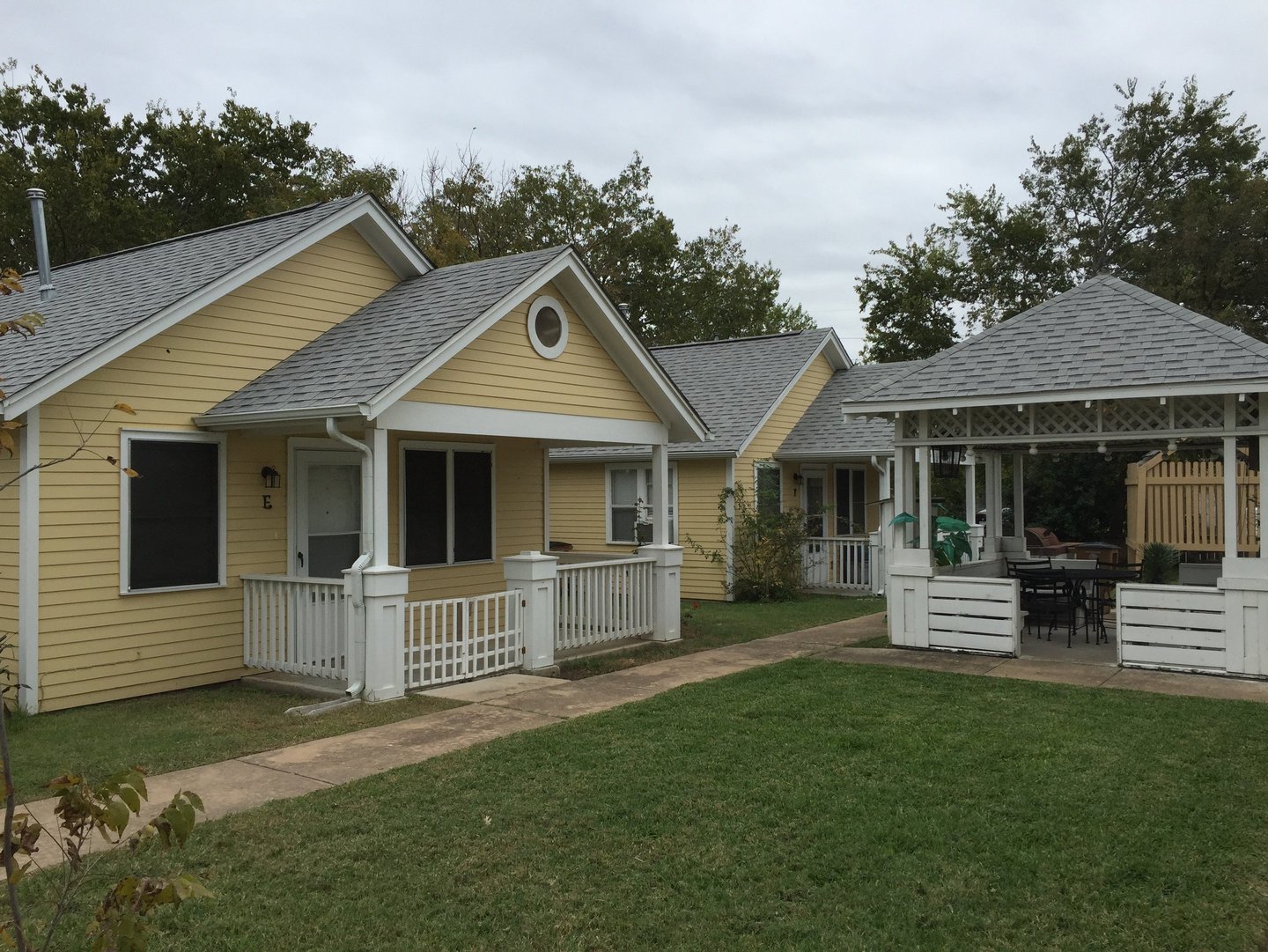
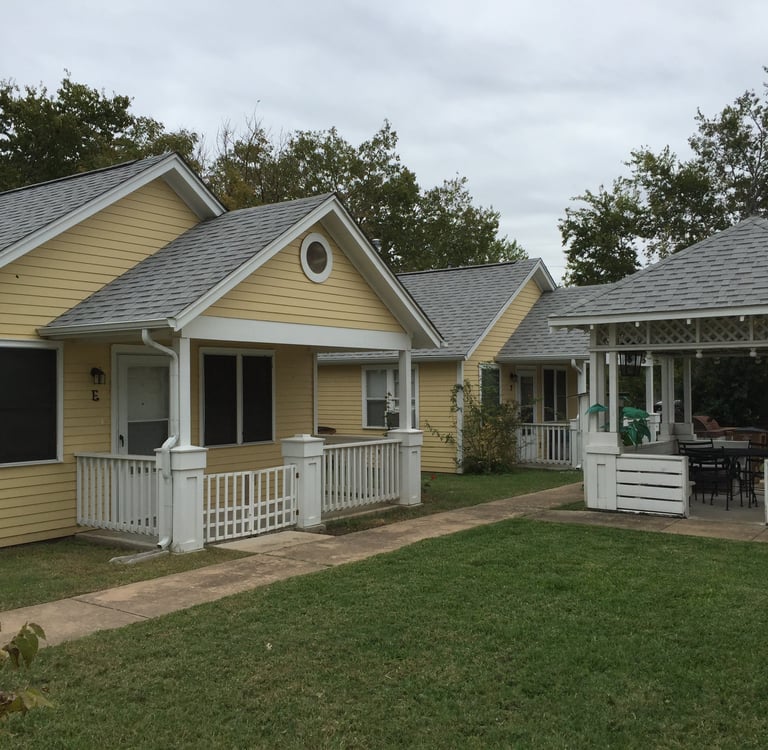
Photo: Robert Shaw Village, where much of the early BCDC communications took place.
Our Story Through Time
For decades, the Blackland neighborhood in Central East Austin bore the costs of decisions made by people far from it. The 1928 Austin Master Plan explicitly called for relocating communities of color from West Austin to East Austin while simultaneously pushing the University of Texas (UT) to expand eastward into those same neighborhoods. The plan was declared racist and officially abandoned by the city in 1956, but UT continued its eastward annexation until 1992. The result was a neighborhood where housing was cheap because it had been left to deteriorate on purpose.
By 1980, UT was pursuing its sixth annexation attempt, one that would have consumed half of Blackland all the way to Chicon Street. That was the breaking point. Residents organized as the Blackland Neighborhood Association and spent the next 12 years fighting the university at every turn. The standoff ended in a hard-won compromise: UT agreed to stop buying properties east of Leona Street and to hand over what it already owned in that area to the neighborhood.
But residents knew that winning the land meant nothing if they couldn't protect it. During the battle, the neighborhood had begun developing its own strategy to fight blight from the inside. In 1983, the Blackland Community Development Corporation was founded to do exactly that: to build, buy, and maintain housing for the people who actually lived there. Of the nonprofit's 51 units, nine are reserved for transitional families, many of them formerly homeless and not unlike those displaced by UT in the 1980s. Six are set aside for elderly residents, four for adults with mental or physical disabilities, and the rest serve income-burdened working families. To keep rents as low as possible, BCDC has always run lean, with a small staff and an austere budget by design.
Most of the early funding came through city-administered HUD grants, supplemented by the 16 houses and eight vacant lots transferred from UT as part of the 1992 agreement. Those properties were rehabilitated through volunteer labor, HUD dollars, and private donations. For years, BCDC deliberately avoided mortgaging its properties, wary of debt service costs that would ultimately be passed on to tenants through higher rents. That position became harder to hold as city and HUD programs increasingly required "leveraging," meaning organizations had to borrow against their assets to qualify for federal subsidies. In 2002, facing the loss of tax exemptions on six vacant lots, BCDC made a pragmatic compromise and borrowed to secure matching HUD HOME funds.
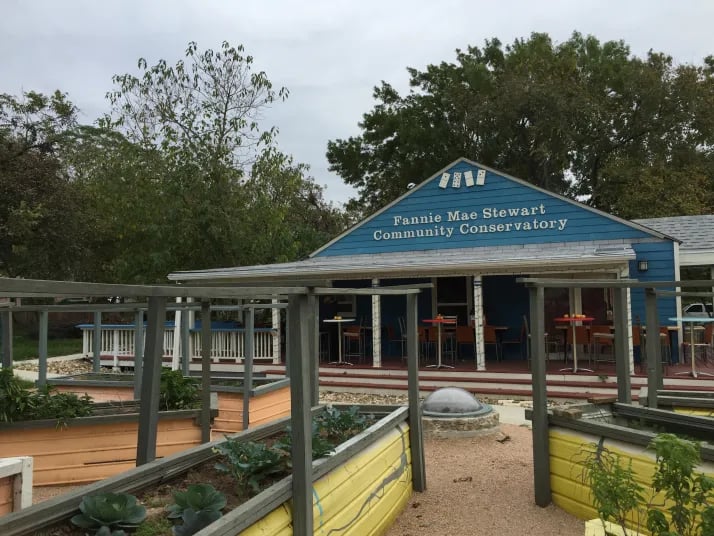
By 2005, the board had shifted to a policy of incremental development, building with donated materials and volunteer labor rather than chasing federal funding with strings attached. Working with Mueller Home Depot and a network of small nonprofits, BCDC coordinated roughly 5,000 hours of volunteer labor annually, putting up two duplexes along 22nd Street and converting a historic bungalow into a community conservatory offering classes in quilting, canning, gardening, and arts and crafts. Several Austin City Council members showed up to volunteer on those projects and left with a sharper understanding of the city policies enabling gentrification. Many of those policies were later revised.
Austin's real estate boom drove up property values and tax assessments across the city, pushing out families who had lived in the neighborhood for generations. BCDC now manages roughly 20 percent of the residential units in Blackland, a foothold significant enough to signal to developers and realtors that this neighborhood is not going anywhere. That presence shapes the market, attracting buyers who value an inclusive community and quietly discouraging those who don't.
Over more than four decades, BCDC has moved steadily toward the vision its founders carried: a neighborhood that genuinely belongs to people of all races, religions, incomes, and backgrounds. It is a vision rooted in Dr. Martin Luther King, Jr.'s dream, and it is one the organization lives out every day. The Dream starts here.
42 Years
51 Units
creating community, not just housing
of keeping families rooted here


Building community and improving lives through quality affordable housing services in the Blackland neighborhood.
Leveraging Hope for good. The Dream Starts Here!
Location & Hours
Fannie Mae Stewart Conservatory
902 E 22nd St,
Austin, TX 78722
Weekdays: 9:00 AM – 4:00 PM
Contact Us
+1 (512) 220-8751
info@blacklandcdc.org
Maintenance: +1 (737) 296-0718 (Emergencies | M-F, 9 AM - 4 PM)
© 2026 Blackland Community Development Corporation. All rights reserved.